Genki Chapter 8 Grammar
8.1.1 Long form (Dictionary Form) v.s. short form (Plain Form or Informal Form)
Usage: The distinction between polite and informal forms is fundamental in Japanese.
- Polite forms are used in formal and respectful contexts, while informal forms are employed in casual conversations with friends, family, or peers.
- This concept applies to various aspects of the Japanese language, including verbs, adjectives, nouns, and more.
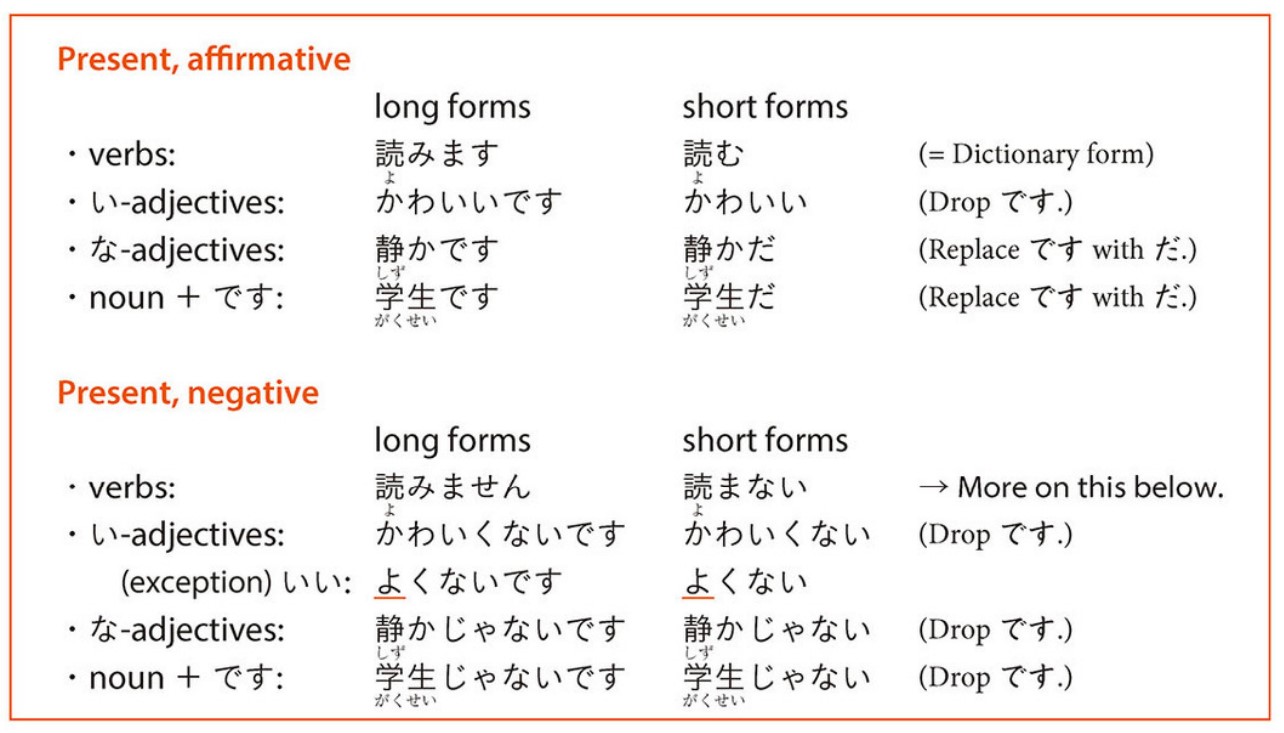
Understanding when to employ polite and informal forms is crucial for effective communication in various social and professional situations in Japanese. It reflects respect and cultural norms in Japanese society.
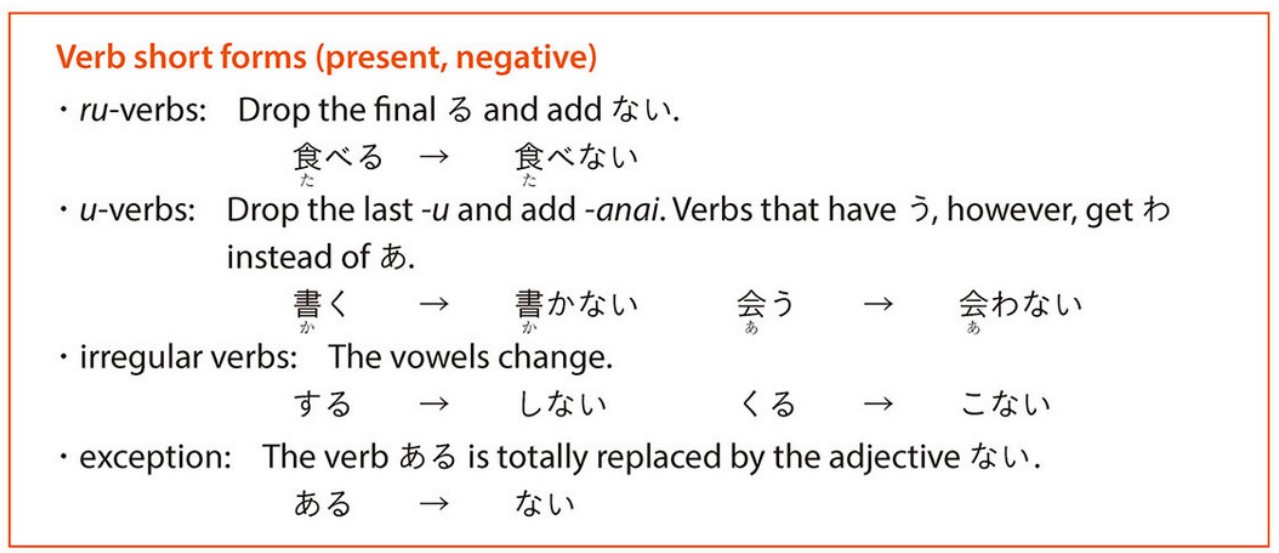
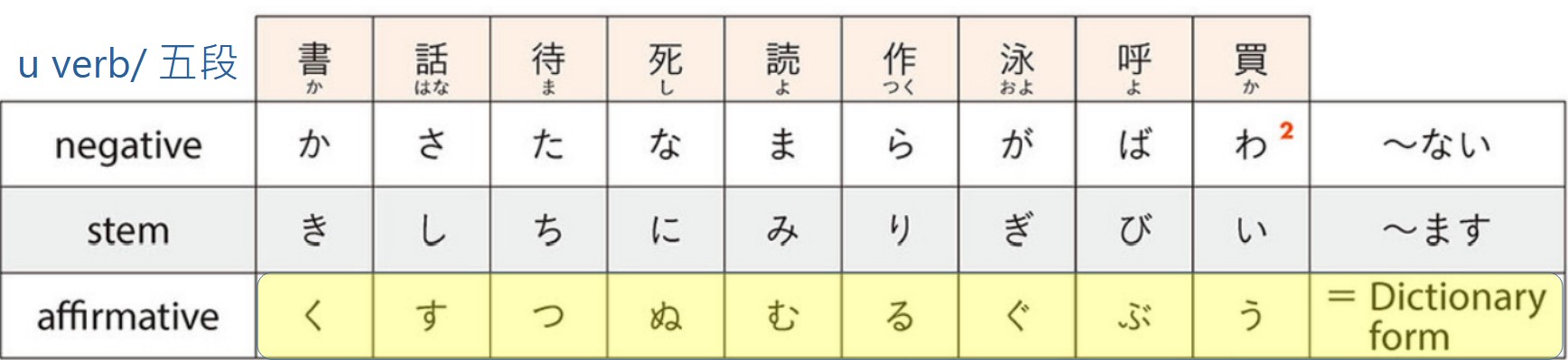
8.1.2 Short form verb’s “present negative” form
8.2 Informal Rules in Japanese Conversations
In casual Japanese conversations, various informal rules govern the language used. These rules make the conversation sound more relaxed and friendly. Here are some of these informal rules with examples in both formal and informal forms:
-
Dropping the Question Particle か (Question Ending Particle):
- In casual conversations, the question particle か (ka) is often dropped, and rising intonation is used to indicate a question.
Examples:
- Formal: これは何ですか? (Kore wa nan desu ka?) - What is this?
- Informal: これは何? (Kore wa nan?) - What is this?
-
Dropping the Sentence-Final だ (Copula “is”):
- In spoken language, it’s common to drop the sentence-final だ after a な-adjective or a noun.
- However, you may keep だ when you want to add emphasis or follow it up with ね (ne) or よ (yo) for clarification or emphasis.
-
Using うん (un) and ううん (uun) for Yes and No:
- In informal conversations, はい (hai) for “yes” and いいえ (iie) for “no” are usually replaced by うん (un) and ううん (uun), respectively.
Examples:
- Formal: はい、そうです。 (Hai, sou desu.) - Yes, that’s right.
- Informal: うん、そうだよ。 (Un, sou da yo.) - Yeah, that’s right.
-
Using Contractions:
- Japanese speakers often use contractions to simplify sentences and make them more concise. Common contractions include:
- じゃない (janai) → じゃん (jan) for negation.
- です (desu) → だ (da) for sentence endings.
Examples:
- Informal (contraction): これは高いじゃん。 (Kore wa takai jan.) - This is expensive, isn’t it?
- Informal (contraction): そうだよ。 (Sou da yo.) - That’s right.
- Japanese speakers often use contractions to simplify sentences and make them more concise. Common contractions include:
-
Using Sentence-Ending Particles (Yo, Ne, Na):
- Sentence-ending particles like よ (yo), ね (ne), and な (na) are commonly used in informal conversations to add emphasis, seek agreement, or make statements more engaging.
Examples:
- Informal (with よ for emphasis): これは美味しいよ! (Kore wa oishii yo!) - This is delicious!
- Informal (with ね for seeking agreement): 楽しいね。 (Tanoshii ne.) - It’s fun, isn’t it?
- Informal (with な for a friendly assertion): これは静かな場所だな。 (Kore wa shizuka na basho da na.) - This is a quiet place, isn’t it?
8.3 Short Forms in Quoted Speech: ー と思います / ないと思います
Usage: The short form “ーと思います” (ー と おもいます) is commonly used in casual conversation to express one’s thoughts, opinions, or intentions when talking about oneself or others. It provides a straightforward way to convey what someone is thinking without using more elaborate expressions.
Examples:
- 彼は来週の会議に参加すると思います。 (Kare wa raishuu no kaigi ni sanka suru to omoimasu.) - I think he will attend next week’s meeting.
- 私は明日休むと思っています。 (Watashi wa ashita yasumu to omotteimasu.) - I’m planning to take a day off tomorrow.
In these examples, “ーと思います” is used to express a belief or intention.
Short Form in Quoted Speech with Negative: ないと思います
Usage: The short form with negative “ないと思います” (ない と おもいます) is used in a similar manner to express one’s thoughts, opinions, or intentions when talking about oneself or others, but with a negative connotation. It is used to indicate that someone does not believe or intend to do something.
Examples:
- 彼は明日来ないと思います。 (Kare wa ashita konai to omoimasu.) - I don’t think he will come tomorrow.
- 私はこれを買わないと思っています。 (Watashi wa kore o kawanai to omotteimasu.) - I don’t intend to buy this.
8.4 Using Short Forms in Quoted Speech: ー と言っていました (to itteimashita)
Usage: In Japanese, when quoting someone’s speech in indirect or reported speech, you can use the short form of verbs and phrases to convey the content of what was said. This is often done to summarize or paraphrase the original statement.
- The structure typically involves the short form of the verb or phrase followed by ーと言っていました (to itteimashita) to indicate that someone said or mentioned it.
- The short form of verbs and phrases while indicating that it was spoken by someone else.
Examples:
-
彼は来週の会議に
出席しないと言っていました。 (かれはらいしゅうのかいぎにしゅっせきしないといっていました。)- He said that he won’t attend the meeting next week.
- In this example, the short form “出席しない” (attend won’t) is used in reported speech to convey what he said.
-
彼女はその映画が
面白かったと言っていました。 (かのじょはそのえいががおもしろかったといっていました。)- She said that the movie was interesting.
- In this case, “面白かった” (was interesting) is the short form used in reported speech.
-
彼は
明日来ると言っていました。 (かれはあしたくるといっていました。)- He said he will come tomorrow.
- The short form “来る” (come) is used to convey his statement.
-
あの人は新しいプロジェクトに
参加しないと言っていました。 (あのひとはあたらしいぷろじぇくとにさんかしないといっていました。)- That person said that they won’t participate in the new project.
- Here, “参加しない” (participate won’t) is the short form used in reported speech.
8.5 Requesting Someone to Refrain from Doing Something
Usage: To politely request that someone refrains from doing something, you can use the negative verbal short form of the verb followed by “でください” (de kudasai).
Example:
- ここで写真を撮らないでください。 (Koko de shashin o toranaide kudasai) - Please don’t take photos here.
- 道路でゴミを捨てないでください。 (Douro de gomi o sutenaide kudasai) - Please don’t litter on the road.
- 靴を履かないでください。 (Kutsu o hakanai de kudasai) - Please don’t wear shoes.
- 電源を切らないでください。 (Dengen o kiranaide kudasai) - Please don’t turn off the power.
- 他のお客様を妨げないでください。 (Hoka no okyakusama o samatagenai de kudasai) - Please don’t disturb other customers.
- 電車の中で食べないでください。 (Densha no naka de tabenaide kudasai) - Please don’t eat inside the train.
- 他人の荷物に触らないでください。 (Tanin no nimotsu ni sawaranaide kudasai) - Please don’t touch other people’s belongings.
- 机の上に物を置かないでください。 (Tsukue no ue ni mono o okanaide kudasai) - Please don’t place objects on the desk.
- ペットを連れてこないでください (Petto o tsurete konai de kudasai) - Please don’t bring pets.
- 携帯電話を使わないでください (Keitai denwa o tsukawanai de kudasai) - Please don’t use your mobile phone.
8.6.1 動詞の (Verb Short Form + の) => Noun
Usage: The grammar structure “動詞の” is used to turn a verb into a noun that describes an action or activity.
8.6.2 動詞の + が好きです/“が嫌いです
Combine with “が好きです” (ga suki desu - like) or “が嫌いです” (ga kirai desu - dislike) to express one’s preferences or feelings about particular actions or activities they like or dislike doing.
Formation: To use this structure, you take the short form of a verb (i.e., the dictionary form without any conjugation) and attach “の” (no) to it.
Examples:
-
ピアノを弾くのが好きです。 (Piano o hiku no ga suki desu.) - I like playing the piano.
- Here, “ピアノを弾く” (piano o hiku) means “to play the piano,” and “の” (no) turns it into a noun, allowing you to express your liking for this action.
-
スポーツをするのが嫌いです。 (Supootsu o suru no ga kirai desu.) - I dislike doing sports.
- In this example, “スポーツをする” (supootsu o suru) means “to do sports,” and “の” (no) changes it into a noun, indicating your dislike for this activity.
8.6.3 動詞の + が上手です/が下手です
Combined with “が上手です” (ga jouzu desu - is good at) or “が下手です” (ga heta desu - is bad at), it allows you to describe one’s proficiency or lack thereof in doing a particular action or activity.
Formation: To use this structure, take the short form of a verb (i.e., the dictionary form without any conjugation) and attach “の” (no) to it. Then, add “が上手です” (ga jouzu desu) to indicate being good at or “が下手です” (ga heta desu) to indicate being bad at.
Examples:
- 料理を作るのが上手です。 (Ryouri o tsukuru no ga jouzu desu.) - I am good at cooking.
- Here, “料理を作る” (ryouri o tsukuru) means “to cook,” and “の” (no) changes it into a noun, allowing you to say you are good at it.
- ピアノを弾くのが下手です。 (Piano o hiku no ga heta desu.) - I am bad at playing the piano.
- In this example, “ピアノを弾く” (piano o hiku) means “to play the piano,” and “の” (no) turns it into a noun, indicating your lack of proficiency.
- 野球をするのが上手ですか? (Yakyuu o suru no ga jouzu desu ka?) - Are you good at playing baseball?
- “野球をする” (yakyuu o suru) means “to play baseball,” and “の” (no) transforms it into a noun to inquire about one’s skill level.
- 彼女は英語を話すのが上手です。 (Kanojo wa eigo o hanasu no ga jouzu desu.) - She is good at speaking English.
- “英語を話す” (eigo o hanasu) means “to speak English,” and “の” (no) is used to make it a noun describing her proficiency.
Note: Overall, it is particularly useful when you want to describe your interests or abilities in a straightforward manner.
-
料理を作るのが得意です。 (Ryouri o tsukuru no ga tokui desu.) - I am good at cooking.
- “料理を作る” (ryouri o tsukuru) means “to cook,” and “の” (no) is used here to transform it into a noun describing your skill or proficiency.
-
旅行するのが楽しいです。 (Ryokou suru no ga tanoshii desu.) - Traveling is enjoyable.
- In this case, “旅行する” (ryokou suru) means “to travel,” and “の” (no) is used to make it a noun describing the enjoyable activity of traveling.
8.7.1 Usage of the Subject Particle が (Ga) in Japanese
Usage: In Japanese, the particle が (ga) is used as a subject marker to identify the subject or doer of the action in a sentence. It plays a crucial role in specifying the subject and emphasizing it within the sentence.
Examples:
-
犬が走っています。 (Inu ga hashitteimasu.)
- The dog is running.
- In this sentence, “が” (ga) is used to indicate that “犬” (inu, dog) is the subject of the action, which is running. It emphasizes that it’s the dog that is running.
-
彼がピアノを弾いています。 (Kare ga piano o hii teimasu.)
- He is playing the piano.
- Here, “が” (ga) marks “彼” (kare, he) as the subject who is performing the action of playing the piano.
-
彼女が美しい。 (Kanojo ga utsukushii.)
- She is beautiful.
- “が” (ga) is used to specify that “彼女” (kanojo, she) is the subject of the sentence, and it emphasizes her beauty.
-
雨が降っています。 (Ame ga futteimasu.)
- It is raining.
- In this case, “が” (ga) marks “雨” (ame, rain) as the subject, indicating that rain is the one performing the action of falling.
-
先生が教えてくれた。 (Sensei ga oshiete kureta.)
- The teacher taught (me/us).
- “が” (ga) is used to specify that “先生” (sensei, teacher) is the one who performed the action of teaching.
8.7.2: は (Wa) and が (Ga) in Japanese Sentences
Usage: In Japanese, the particles は (wa) and が (ga) are used to mark the subject of a sentence. They have different roles in indicating emphasis and focus.
Examples:
ロバートさんは沖縄に行きました。 (Robāto-san wa Okinawa ni ikimashita.)
Robert went to Okinawa.
- In this sentence, “は” (wa) is used after “ロバートさん” (Robāto-san) to mark him as the topic or known information of the sentence.
- It emphasizes that we are talking about Robert in the context of going to Okinawa.
ロバートさんが沖縄に行きました。 (Robāto-san ga Okinawa ni ikimashita.)
- It was Robert who went to Okinawa.
- Here, “が” (ga) is used after “ロバートさん” (Robāto-san) to mark him as the subject of the sentence.
- It places emphasis on Robert as the doer of the action, highlighting that it was him who went to Okinawa.
8.7.3: Usage of “が” (Ga) with Question Words in Japanese
Usage: In Japanese, when question words like “だれ” (dare, who) and “なに” (nani, what) are used as the subject of a sentence, they are followed by the particle “が” (ga) rather than “は” (wa). This is a grammatical rule in Japanese.
- It helps specify the subject of the question and is an important aspect of Japanese sentence structure.
Examples:
-
だれが来ましたか? (Dare ga kimashita ka?)
- Who came?
-
だれが勝ちましたか? (Dare ga kachimashita ka?)
- Who won?
-
だれがこの本を読みましたか? (Dare ga kono hon o yomimashita ka?)
- Who read this book?
-
なにが起きましたか? (Nani ga okimashita ka?)
- What happened?
-
なにがおいしいですか? (Nani ga oishii desu ka?)
- What is delicious?
8.7.4 Usage of “が” (Ga) with Nouns in Japanese Questions
Usage: In Japanese, when you ask a question that seeks to identify a specific noun (e.g., “What is it?” or “Who is it?”), the noun that provides the answer to the question is also followed by the particle “が” (ga). This is a common structure in Japanese questions.
Examples:
-
何がありますか? (Nani ga arimasu ka?)
- What is there?
- In this question, “何” (nani, what) is seeking to identify a specific noun (the answer), and the noun that answers the question is marked with “が” (ga). For example, you could answer with “本
があります” (hon ga arimasu, There are books).
-
だれが来ましたか? (Dare ga kimashita ka?)
- Who came?
- Here, “だれ” (dare, who) is the question word identifying the specific noun (the answer), and “が” (ga) is used to mark the noun that answers the question. For example, you could answer with “田中さん
が来ました” (Tanaka-san ga kimashita, Tanaka came).
-
どれが好きですか? (Dore ga suki desu ka?)
- Which one do you like?
- In this question, “どれ” (dore, which one) is seeking to identify a specific noun (the answer), and “が” (ga) is used to mark the noun that answers the question. For example, you could answer with “この本
が好きです” (kono hon ga suki desu, I like this book).
-
どの店がおすすめですか? (Dono mise ga osusume desu ka?)
- Which shop do you recommend?
- “どの” (dono, which) seeks to identify a specific noun (the answer), and “が” (ga) marks the noun that answers the question. For example, you could answer with “あのカフェ
がおすすめです” (Ano kafe ga osusume desu, That cafe is recommended).
8.8 Usage of 何か (Nanika) and 何も (Nanimo) in Japanese
Usage: In Japanese, the words “何か” (nanika) and “何も” (nanimo) are used to express the concepts of “something” and “anything” in various contexts. Their usage can vary depending on the sentence structure and whether it is a positive statement, a question, or a negative statement.
- When “何か” (nanika) and “何も” (nanimo) are used in sentences where particles (は, が, を) are expected, they are often used on their own without additional particles. These words are versatile and can be employed in a wide range of situations to express the presence or absence of something or anything, depending on the context and sentence structure.
Examples:
-
Positive Statements (Something):
- 何か食べたいです。 (Nanika tabetai desu.)
- I want to eat something.
- 何か特別な贈り物がありますか? (Nanika tokubetsu na okurimono ga arimasu ka?)
- Is there something special as a gift?
- 何か食べたいです。 (Nanika tabetai desu.)
-
Questions (Anything):
- 何か質問がありますか? (Nanika shitsumon ga arimasu ka?)
- Do you have any questions?
- 何かお手伝いできますか? (Nanika otetsudai dekimasu ka?)
- Can I help with anything?
- 何か質問がありますか? (Nanika shitsumon ga arimasu ka?)
-
Negative Statements (Not Anything):
- 何も心配しないでください。 (Nanimo shinpai shinai de kudasai.)
- Don’t worry about anything.
- 何も持っていません。 (Nanimo motteimasen.)
- I don’t have anything.
- 何も心配しないでください。 (Nanimo shinpai shinai de kudasai.)