Accent
Concept: Japanese only have high (sound 1) / low pitch (sound 3)
- The so-called accent refers to the difference in high and low tones.
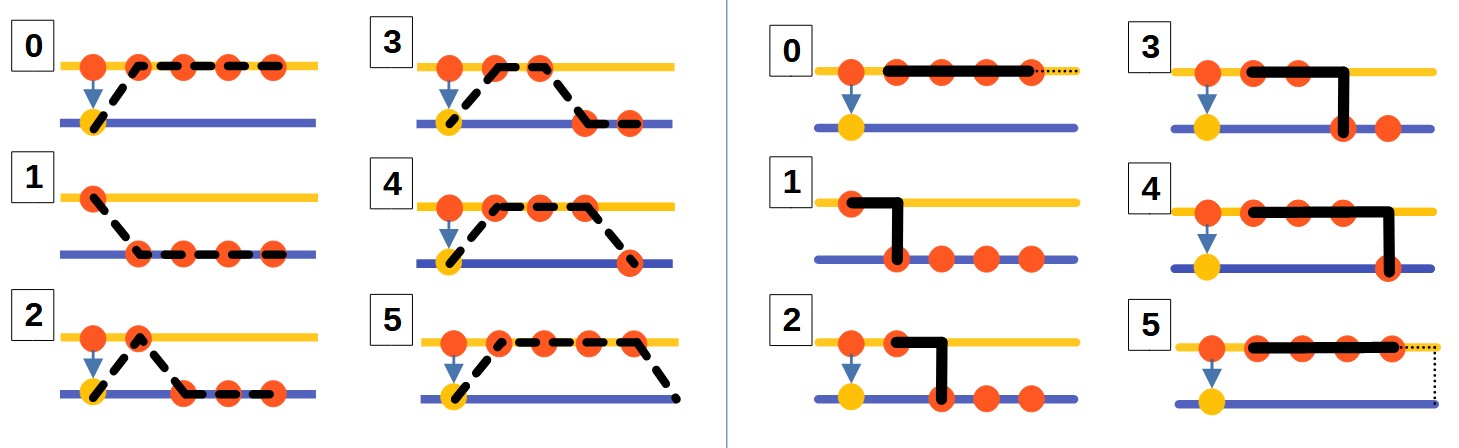
Regarding the left-hand side style graph:
-
Here, Regardless of the length of the word, we always use five beats for practice, with each sound placed on the upper track.
-
This tells you that Japanese only has high and low tones, not four tones.
-
Each graph represents a set, with one high and one low line. If a word is a “zero-th sound,” then each sound is on the upper track, meaning they are all high.
-
Why choose five-beat words? Because we assume that words have five beats.
- In other words, if a series of words only has three beats, it means that the five beats we’ve practiced are sufficient to handle it.
- If a word only has two beats, then after practicing five beats, the first two beats are also within our practice range.
-
Why not use six or seven beats to practice? Wouldn’t that provide a wider and safer range?
- In fact, it wouldn’t, because very few words in Japanese exceed five beats.
- Even if there are words with more than five beats, most of them are compound nouns, and in such cases, there’s a rule for the high and low tones of compound nouns, so there’s no conflict.
-
So, for a basic word, there are rarely more than five beats, so we practice all possibilities with five beats.
Japanese is counted by beats, which is completely different from how we express in Chinese.
-
Chinese doesn’t rely on beats; otherwise, you wouldn’t be able to pronounce the four tones.
-
When pronouncing the Japanese hiragana, you can grasp one key point: don’t drag it out, and focus on the logic of the beats.
-
The “first sound” means that the first sound is on the upper track, while the others are on the lower track.
-
You can also say that if a word is written with the “first sound,” it tells you that after pronouncing the first sound, the other sounds should descend, and so on.
-
“Second sound” means that after pronouncing the second sound, it should descend from behind the second sound.
-
The graph for the “fifth sound” temporarily looks similar to the “zeroth sound.” The difference is that for the “zero-th sound,” if there’s a sixth circle, it goes on the upper track, while for the “fifth sound,” if there’s a sixth circle, it means the word has more than six beats, and the sixth beat goes on the lower track. However, because we currently practice with five beats, “zeroth sound” and “fifth sound” may appear somewhat similar.
-
In summary, Japanese doesn’t have four tones; we should treat it as if we’re singing, because it’s indeed based on beats.
- When singing, there’s a starting note, and if you don’t start well, you might go off-key.
- So, the starting note in Japanese and the following second note cannot be at the same pitch; they must have a difference to clearly indicate where the starting note begins.
-
Almost all words follow this rule. If you master this practice well, you can handle any word easily.
原文
所謂的accent就是高低音的差別。為什麼要選擇五拍的單字呢?因為我們假設單字都有五拍,換句話說,如果一個系列的單字只有三拍,那麼我們練習的五拍就足夠應付了。如果一個單字只有兩拍,那麼在我們練習過五拍的情況下,前兩拍當然也在我們的練習範圍內。
也許你會問,為什麼不用六拍或七拍來練習,這樣範圍更廣,更保險嗎?實際上不是這樣的,因為很少有單字超過五拍。即使有超過五拍的單字,大部分都是複合名詞,而對於複合名詞,有一個高低音的規則,所以也不會有衝突。
因此,基本上很少有單字超過五拍,所以我們以五拍來練習所有可能性。日文是按拍子來念的,這與中文表達方式完全不同。中文不能用拍子來限制,否則你的四聲就無法發出來。在念五十音的時候,你可以捕捉到一個重點,不要拖泥帶水,抓住拍子的邏輯。
現在來看所謂的零號音。不管單字的長短,我們都使用五拍來練習,每個音都發在上面的軌道。這告訴你日文只有高音和低音,沒有四聲。每個圖表示一組,有一條高音和一條低音。如果一個單字是零號音,那麼每個音都在上面的軌道,都是高音。
一號音意味著第一個音在上面,其他音在下面。你也可以這樣講,如果一個單字寫成一號音,那麼它告訴你,第一個音發完後,其他音都要降下來,以此類推。二號音是指第二個音發完後,從第二個音的後面就要降下來。
五號音的圖形與零號音暫時看起來相似。差異在於,零號音如果有第六個圈圈,它的第六個圈圈會在上面,而五號音如果有第六個圈圈,那麼這個單字就有超過六拍,它的第六拍就要劃在下面。不過,目前我們使用五拍練習,所以零號音和五號音看起來有些相似。
總之,日文沒有四聲,我們應該把它當作在唱歌一樣,因為它確實是按拍子來念的。在唱歌時,有一個起頭音,如果你的起頭音發不好,後面就容易走音。所以日文的起頭音和接下來的第二個音不能是相同的高度,它們必須有一個差距,以明確指示起頭音是從哪裡開始。
總之,原則上,大致上所有的單字都遵循這個規則。如果你對這個練習掌握得很好,任何一個單字都可以輕鬆應對。
Regarding right-hand side style graph:
- How to read:
- straight - high pitch (sound 1)
- after straight (when go down) - low pitch (sound 3)
- if no marker - low pitch (sound 3)
原文
通則1:通常第一個音(低)跟第二個音(高) 通則2:一個單字最多只有一個山(起伏)
快速看法: Marker只有一或三聲,平的發一聲,直的後面發三聲,沒有符號發三聲。
日語的重音:「高低重音」,聲調由高往下降的「臨降點」就是重音的位置
日語的重音類型:
- 平板型: 單字發音沒有高低落差,即没有「臨降點」
- 起伏型: 單字發音有高低落差的「臨降點」,再依「臨降點」的位置分為:
- 頭高型
- 中高型
- 尾高型
平板型:
- 單字發音沒有高低落差的「臨降點」,所以稱之為「平板型」,重音符號用「0」表之。
- 通常起音的第一個音低,第二個音拉高之後,再也沒有降下來, 後面的助詞也跟著高。
- 絕大多數日文單字是平板型
頭高型
- 第一音高,第二音以後降低,持續到最後,後有助詞時, 該助詞保持一樣的低度。
- 此重音形式因第一音就降下來 (臨降點在第一個位置),所以重音符號以「1」表之。
中高型
- 第一音低,第二音以後拉高到中間的某個音再降下來。 其重音的符號視其「臨降點」的位置而定。
- 在第2個位置降下來就以「2」表之,若在第3個位置降下來則以「3」表之,以此類推。
尾高型
- 第一音低,第二音以後拉高到最後音,若後面有助詞,則該助詞降低。
- 「尾高型」的重音符號,視最後音為第幾個音而定,比如二音節的音以「2」表之,三音節則以「3」表之,以此類推。
- 「尾高型」與「平板型」的單字,後面不接助詞,單獨發音時,其高低完全一樣,最根本的不同在於後面接有助詞時,「尾高型」的助詞要降低,「平板型」的助詞則保持一樣的高度。
觀念:
- 起伏型的「頭高型·中高型」従前面的音節算起位置都不一致,但如果從後面的音節算起的話,其都是倒數第三個音節「-3」。
- 兩個名詞連接成一個名詞時,重音移至第二個字的第一個音節。
動詞·形容詞的字典形和名詞一樣有一定的重音,但是動詞有活用, 其重音會因語尾助詞的不同而產生位置的改変,但有一定的規則。 動詞平板型
- [ない·た·て·たい·そうだ·ながら]→0平板
- [●ば·●う]→-2(倒數第二音)
動詞起伏型:
- [ない·た·て·ば] →-3(倒數第三音)
- [たい·そうだ·ながら]→(助詞的第一個音)
- [●う]→-2(倒數第二音)
形容詞重音的変化規則
形容詞平板型:
- [く]→0平板
- [●〇て]→-3
- [ない]→ー2
- [かろう]→–2
- [●かった(ら·り)]→「か」的前音
- [●ければ]→「け」的前音
- ※把[かった] [ければ]看成一個單位→-2倒數第二音
形容詞起伏型:
- [●〇<][●〇かった(ら·り)] [●〇ければ]
- ※把 [<] [かった] [ければ]看成一個單位 →-3倒數第三音
## 0-th sound
か、い、ち、け、は、

せみ、いす、ほし、むし、かぜ、

さかな、すいか、さくら、でんわ、きって、

きょうしつ、えんぴっ、しつもん、やきにく、びょういん、

きむらさん、たなかさん、ぬいぐるみ、もういちど、きっさてん、

おすしゃさん、せんたくもの、がくせいしゅう