Genki Chapter 9 Grammar
9.1.1 Past Tense Paradigm of Short Forms: Verbs
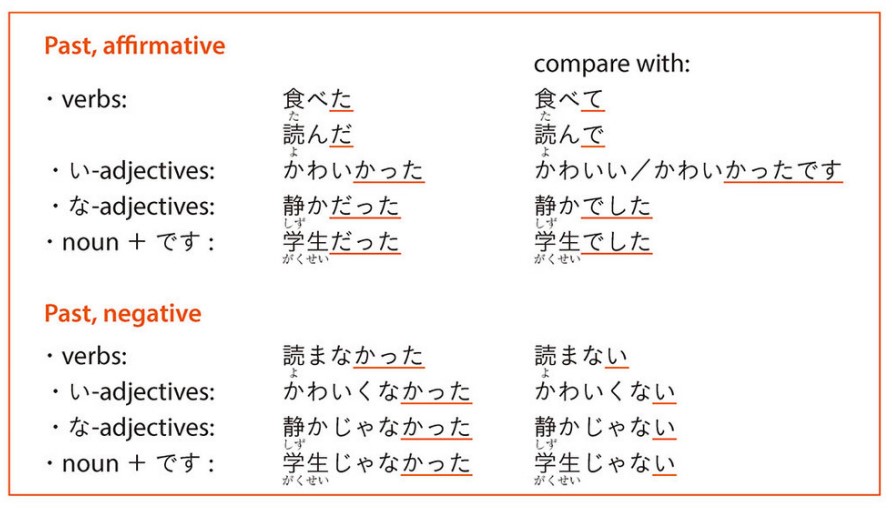
Usage: The past tense in Japanese is formed by replacing the te-form endings て and で with た and だ, respectively, for verbs.
Examples:
- 食べています (tabeteimasu) - I am eating.
- Past tense: 食べた (tabeta) - I ate.
- 行っています (itteimasu) - I am going.
- Past tense: 行った (itta) - I went.
In Japanese, verbs in the past tense are typically formed by changing the endings of the て-Form.
- The te-forms are a crucial part of Japanese verb conjugation and are used to connect verbs together or with other sentence elements.
To create the past tense for short forms (also known as plain forms) of verbs, follow these rules:
-
For verbs ending in う (u), such as 食べる (taberu), replace the て-form ending て (te) with た (ta).
- 食べて (tabete) (te-form) → 食べた (tabeta) (past tense)
-
For verbs ending in る (ru), such as 行く (iku), replace the て-form ending て (te) with た (ta).
- 行って (itte) (te-form) → 行った (itta) (past tense)
-
For verbs ending in く (ku), replace the て-form ending て (te) with た (ta).
- 書いて (kaite) (te-form) → 書いた (kaita) (past tense)
-
For verbs ending in ぐ (gu), replace the て-form ending て (te) with だ (da).
- 泳いで (oyoide) (te-form) → 泳いだ (oyoida) (past tense)
-
For verbs ending in す (su), replace the て-form ending て (te) with した (shita).
- 勉強して (benkyoushite) (te-form) → 勉強した (benkyoushita) (past tense)
9.1.2 The Past Tense Paradigm of Short Forms: い-Adjectives
Usage: In Japanese, the past tense for い-adjectives is formed by replacing the last い with かった. You can also think of it as ‘dropping です from the long form.’
Examples:
- 高いです (takai desu) - It is tall.
- Past tense: 高かった (takakatta) - It was tall.
- 美味しいです (oishii desu) - It is delicious.
- Past tense: 美味しかった (oishikatta) - It was delicious.
In Japanese grammar, adjectives are categorized into two main groups: い-adjectives and な-adjectives. When expressing the past tense for い-adjectives, the process is straightforward:
- For い-adjectives such as 高い (takai) and 美味しい (oishii), replace the last い (i) with かった (katta) to indicate the past tense.
Here’s how you can create the past tense for い-adjectives:
- For adjectives like 高い (takai) and 美味しい (oishii) that end in い (i), simply remove the い and add かった (katta).
- 高い (takai) (present) → 高かった (takakatta) (past)
- 美味しい (oishii) (present) → 美味しかった (oishikatta) (past)
9.1.3 The Past Tense Paradigm of Short Forms: な-Adjectives and Nouns
Usage: In Japanese, the past tense for な-adjectives and nouns is formed by replacing the long form でした (deshita) ending with だった (datta). For negation, the ない (nai) ending conjugates as an い-adjective, and you can replace the last ない with なかった (nakatta) for all categories.
Examples:
- 静かでした (shizukadeshita) - It was quiet.
- Past tense: 静かだった (shizukadatta) - It was quiet.
- 学生でした (gakuseideshita) - It was a student.
- Past tense: 学生だった (gakuseidatta) - It was a student.
9.1.4 The Past Negative Tense Paradigm of Short Forms
Negation:
For negation, the ない (nai) ending conjugates as an い-adjective. Therefore, for all categories (な-adjectives, nouns, and verbs), you can replace the last ない (from present negative form for short form verb) with なかった (nakatta) to indicate the negative past tense.
Examples:
- 静かではない (shizukade wanai) - It is not quiet.
- Negative past tense: 静かではなかった (shizukade wanakatta) - It was not quiet.
- 学生ではない (gakusei de wanai) - It is not a student.
- Negative past tense: 学生ではなかった (gakusei de wanakatta) - It was not a student.
9.2 Short Form Past Tense in Informal Japanese
In informal Japanese conversations, short form predicates in the past tense are used in a similar way to present tense forms. This allows for a straightforward discussion of past events and actions. Here are some key points about using short form past tense, along with examples:
-
Dropping the Question Particle か (Question Ending Particle):
- Similar to present tense, the question particle か (ka) is often dropped in informal speech when asking questions.
Example:
- Formal: けさ、朝ご飯を食べたか? (Kesa, asagohan o tabeta ka?) - Did you have breakfast this morning?
- Informal: けさ、朝ご飯を食べた? (Kesa, asagohan o tabeta?) - Did you have breakfast this morning?
-
Using うん (un) and ううん (uun) for Yes and No:
- Just like in the present tense, in informal speech, はい (hai) for “yes” and いいえ (iie) for “no” are commonly replaced by うん (un) and ううん (uun), respectively.
Examples:
- Informal (with うん for “yes”): うん、食べた。 (Un, tabeta.) - Yeah, I ate.
- Informal (with ううん for “no”): ううん、食べなかった。 (Uun, tabenakatta.) - No, I didn’t eat.
-
Maintaining だった (Datta) in Informal Speech:
- Unlike the present tense, where だ (da) is often dropped in informal speech, だった (datta) in the past tense is typically retained in informal conversations.
Examples:
- Informal (with だった for “was/were”): 先週は忙しかった? (Senshuu wa isogashikatta?) - Were you busy last week?
- Informal (with だった for “wasn’t/weren’t”): ううん、忙しくなかった。 (Uun, isogashikunakatta.) - No, I wasn’t busy. ひまだった。 (Hima datta.) - I had free time.
9.3 Past Tense Short Form in Quoted Speech with ~と思います (I Think)
Usage: Just like in the present tense, you can use the short form in the past tense with the expression
と思います (to omoimasu), which means “I think” or “I believe,” to report what you think took place in the past.
- This allows you to share your thoughts and beliefs about past events.
-
Using ~と思います to Report Past Actions:
- You can use ~と思います to suggest or express your belief about past actions or events.
Examples:
-
A: あ、私のとんかつがない! (A, watashi no tonkatsu ga nai!) - Oh no, my tonkatsu is gone! B: トムさんが食べたと思います。 (B: Tomu-san ga tabeta to omoimasu.) - I think Tom probably ate it.
-
去年の冬はあまり寒くなかったと思います。 (Kyonen no fuyu wa amari samuku nakatta to omoimasu.) - I believe last winter wasn’t very cold.
9.4 Past Tense Short Form in Quoted Speech with ~と言っていました
Usage: ~と言っていました (~to itteimashita) is used to report or quote what someone said in the past tense. It is commonly used when relaying information or statements made by others.
- Note: Japanese does not have a strict “sequence of tense” rule like some other languages, so the tense of the reported speech is preserved when it is reported.
- If the original statement used the present tense, it should be reported with the present tense inside the quote, and if it used the past tense, it should be reported with the past tense.
Examples:
-
ヤスミンさんは、昼ご飯を食べなかったと言っていました。 (Yasmin said that she didn’t have lunch.)
-
彼は昨日、遅刻しなかったと言っていました。 (He said that he wasn’t late yesterday.)
-
先生はテストの結果を見せてくれると言っていました。 (The teacher said that they would show us the test results.)
-
彼女は明日来ると言っていました。 (She said that she would come tomorrow.)
9.5.1 Noun Modification**
Some common forms of noun modification in Japanese:
- No (の) Particle: The most basic and versatile way to modify a noun is by using the の particle. It is used to show possession, association, or description. You can think of it as similar to the English possessive “‘s.”
Usage: This method involves adding の between two nouns, where the first noun modifies the second noun.
Examples:
- 猫の鳴き声 (Neko no nakigoe) - The sound of a cat (possessive)
- 友達の家 (Tomodachi no ie) - Friend’s house (association)
- 高いビルの前 (Takai biru no mae) - In front of a tall building (description)
- I-Adjective Modification: I-adjectives can directly modify nouns by attaching them before the noun.
Usage: Simply place the i-adjective in front of the noun it modifies.
Examples:
- 新しい車 (Atarashii kuruma) - New car
- 高い山 (Takai yama) - High mountain
- 美味しい料理 (Oishii ryouri) - Delicious dish
- Na-Adjective Modification: Na-adjectives, which end in な, need the particle な to modify nouns.
Usage: Add な after the na-adjective before the noun.
Examples:
- 静かな部屋 (Shizuka na heya) - Quiet room
- きれいな花 (Kirei na hana) - Beautiful flower
- 丁寧な言葉 (Teinei na kotoba) - Polite words
-
Relative Clauses (No-Form): Japanese allows for relative clauses to modify nouns, often referred to as the “no-form.” This method is similar to creating sentences but used within a sentence to modify a noun.
- Usage: Place the clause in question before the noun, followed by の.
Examples:
- 昨日買った本 (Kinou katta hon) - The book I bought yesterday
- 大学に行く友達 (Daigaku ni iku tomodachi) - The friend who is going to college
- 私が愛する人 (Watashi ga aisuru hito) - The person I love
9.5.2 Noun Modification with Verbs in Japanese
In addition to using adjectives and relative clauses, you can also modify nouns using verbs in Japanese.
- Dictionary Form Verb Modification: You can use the dictionary (plain) form of verbs to modify nouns. This often indicates a simple action or characteristic associated with the noun.
Usage: Place the dictionary form of the verb before the noun.
Examples:
- 泳ぐ人 (oyogu hito) - A person who swims
- 食べる時間 (taberu jikan) - Eating time
- 走る犬 (hashiru inu) - A dog that runs
- Te-Form Verb Modification: The te-form of a verb is frequently used to modify nouns, indicating an action in progress or a state associated with the noun.
Usage: you can use the combination of a verb in its te-form (て-form) followed by いる (iru) to modify nouns. This construction is used to describe an ongoing action or a state that is in progress.
Examples:
- 食べている人 (tabeteiru hito) - A person who is eating
- 読んでいる本 (yondeiru hon) - A book that is being read
- 歩いている犬 (aruiteiru inu) - A dog that is walking
- 笑っている子供 (waratteiru kodomo) - A child who is laughing
- 聞いている音楽 (kiiteiru ongaku) - Music that is being listened to
- Noun + Suru (する): You can use the verb する (suru) to turn nouns into verbs, and then these verb-nouns can be used to modify other nouns.
Usage: Add the noun + する to create a verb-noun, which can be used to modify another noun.
Examples:
- 勉強する友達 (benkyou suru tomodachi) - A friend who studies
- 料理する人 (ryouri suru hito) - A person who cooks
- 運転する車 (unten suru kuruma) - A car that is being driven
- Potential Form Verb Modification: The potential form of a verb can be used to indicate the ability or possibility of an action related to the noun.
Usage: Attach the potential form of the verb directly to the noun.
Examples:
- 話せる人 (hanaseru hito) - A person who can speak
- 書ける手紙 (kakeru tegami) - A letter that can be written
- 行ける場所 (ikeru basho) - A place that can be visited
9.6.1 もう~ました (Mou ~ Mashita): Have already ..
Usage: “もう~ました” (mou ~ mashita) is used to express that an action has already been completed or that something has already happened.
- It is often translated as “have already [verb]” or “has already [verb]” in English.
- This grammar structure is used to emphasize the completion of an action or event that has already taken place, usually in the recent past, leading up to the present moment. It indicates that there is no need to perform that action again at the current time.
Examples:
-
もう食べました。 (Mou tabemashita.)
- Translation: I have already eaten.
-
彼はもう帰りました。 (Kare wa mou kaerimashita.)
- Translation: He has already gone home.
-
もう宿題を終えました。 (Mou shukudai o oemashita.)
- Translation: I have already finished my homework.
-
彼女はもう日本に行きました。 (Kanojo wa mou Nihon ni ikimashita.)
- Translation: She has already gone to Japan.
-
もう新しい本を読みました。 (Mou atarashii hon o yomimashita.)
- Translation: I have already read a new book.
-
Compare:
もう宿題をしました。: I have already done the homeworkきのう宿題をしました。 : I did the homework yesterday.
9.6.2 まだ~でいません (Mada ~ Deimasen): Have not … yet
Usage: “まだ~でいません” (mada ~ deimasen) is used to express that an action or state has not occurred or been completed yet.
- It is often translated as “have not [verb] yet” or “has not [verb] yet” in English.
- This grammar structure is used to indicate that an action or state has not occurred up to the present moment, emphasizing the lack of completion.
Examples:
-
彼はまだ帰っていません。 (Kare wa mada kaetteimasen.)
- Translation: He has not returned yet.
-
私たちはまだ食べていません。 (Watashitachi wa mada tabeteimasen.)
- Translation: We have not eaten yet.
-
まだ宿題が終わっていません。 (Mada shukudai ga owatteimasen.)
- Translation: I have not finished my homework yet.
-
彼女はまだここに来ていません。 (Kanojo wa mada koko ni kiteimasen.)
- Translation: She has not arrived here yet.
-
まだ新しい車を買っていません。 (Mada atarashii kuruma o katteimasen.)
- Translation: I have not bought a new car yet.
-
Compare:
まだ宿題をしていません。: I have not done the homework yet.きのう宿題をしませんでした。: I did not do the homework yesterday.
9.7 から (Kara) for Explanation in Japanese Grammar
Usage: In Japanese, から (kara) is a versatile conjunction used to provide explanations or reasons for actions, situations, or statements. It is commonly employed to clarify the cause or rationale behind something.
-
Usage in Sentences:
- When から (kara) is used to explain or provide a reason, it is typically placed at the end of a sentence or clause.
- It can be used in both formal and informal contexts.
-
Example Sentences:
- 彼は運転が得意です。だ
から車を持っています。 (Kare wa unten ga tokui desu. Dakara kuruma o motteimasu.)- Translation: He is good at driving. That’s why he owns a car.
- 今日は雨が降っている
から、傘を持って行きます。 (Kyou wa ame ga futteiru kara, kasa o motte ikimasu.)- Translation: Since it’s raining today, I will take an umbrella with me.
- 昨日遅くまで勉強した
から、今日は疲れています。 (Kinou osoku made benkyou shita kara, kyou wa tsukareteimasu.)- Translation: I studied late into the night yesterday, so I’m tired today.
- 彼は運転が得意です。だ