Verb variation summary
Te-form specific (across verb categories)
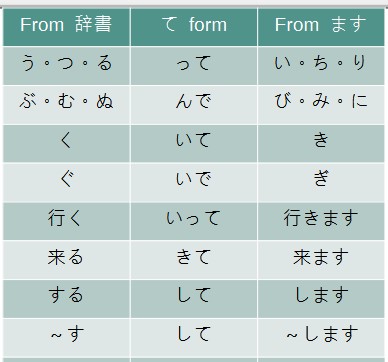
- modified from here
- Te form song
- Te form practice
Type 1 (Godan, 五段, u-) verb variations
-
The dictionary form determines which column to use for this verb, and the conjugation form determines which row to use in the table.
-
Exceptions
- 『行きます』の「て形」⇒『行って』 / 「た形」⇒『行った』
- 『有ります』の「ない形」⇒『ない』/ 「なかった形」⇒『なかった』
| 行* | 有* | Variations | ||||||||
|---|---|---|---|---|---|---|---|---|---|---|
| 会(あ) | 書(か) | 泳(およ) | 話(はな) | 待(ま) | 遊(あそ) | 読(よ) | 帰(かえ) | |||
| 買(か) | 置(お) | 急(いそ) | 貸(か) | 立(た) | 死(し) | 呼(よ) | 飲(の) | 売(う) | ||
| あ段 | わ | か | が | さ | た | な | ば | ま | ら | 🔹ない形[+ない] 🔹なかった形[+なかった] 🔹 受身形、尊敬形[+れる/+れます] 🔹 使役形 [+せる] |
| い段 | い | き | ぎ | し | ち | に | び | み | り | ます形[+ます] |
| う段 | う | く | ぐ | す | つ | ぬ | ぶ | む | る | 辞書形[+X] / 禁止形[+な] |
| え段 | え | け | げ | せ | て | ね | べ | め | れ | 命令形[+X] / 可能形[+る] / 条件形[+ば] |
| お段 | お | こ | ご | そ | と | の | ぼ | も | ろ | 意向形[+う] |
| 音便 | っ | い | い | し | っ | ん | ん | ん | っ | て形[+て(で)] / た形[+た(だ)] |
| " | " | " | " |
Example: 買う
- 買
わない: ない形 - 買
わなかった: なかった形 - 買
われる: 受身形/尊敬形 normal form - 買
われます: 受身形/尊敬形 polite form - 買
わせる: 使役形
- 買
います: ます形
- 買
う-: 辞書形 —> う —> variations with わいうえお - 買
うな: 禁止形
- 買
え-: 命令形 - 買
える: 可能形 - 買
えば: 条件形
- 買
おう: 意向形
- 買
って: て形 - 買
った: た形
| Verb Form | Scenario (Usage Example) | Example Sentence in Japanese | Translation |
|---|---|---|---|
| Negative form ない形 +ない | Expressing a negative action (not buying) | 彼は決して買わない (kare wa kesshite kawanai). | He never buys. |
| Past negative form なかった形 +なかった | Describing the negative past action of not buying | 昨日、彼は店に買わなかった (kinou, kare wa mise ni kawanakatta). | Yesterday, he didn’t buy at the store. |
| Respectful forms 尊敬形 | Showing respect in formal situations | 新しい車を社長に買われました. (Atarashii kuruma o shachou ni kawaremashita.) | Are you buying, sir/madam? |
| Passive forms 受身形 | Describing an action happening to the subject | 商品が顧客によって買われることがあります。(Shouhin ga kokyaku ni yotte kawareru koto ga arimasu.) | Products can be bought by customers. |
| Causative form 使役形 | Indicating causing someone to buy | 私は友達に買わせる。(Watashi wa tomodachi ni kawaseru.) | I make my friend buy. |
| Polite form ます形 | Polite and formal speech, everyday conversations | 彼はいつも食材を買います (kare wa itsumo shokuzai o kaimasu). | He always buys groceries. |
| Dictionary form 辞書形 | Base, plain form for general statements | 彼は毎日新聞を買う (kare wa mainichi shinbun o kau). | He buys the newspaper every day. |
| Prohibitive form 禁止形 | Giving a strong command or prohibition | ここで買うな (koko de kau na). | Don’t buy here. |
| Imperative form 命令形 | Giving a direct command or request | 買え! (kae!) | Buy it! |
| Potential form 可能形 | Expressing the ability to buy | 彼女は高価なものを買える (kanojo wa koukana mono o kaeru). | She can buy expensive things. |
| Conditional form 条件形 | Expressing a condition or possibility | 買えば、お金を節約できます (kaeba, okane o setsuyaku dekimasu). | If you buy, you can save money. |
| Volitional form 意向形 | Expressing intention or suggesting an action | 今晩、買おう (konban, kaou). | Let’s buy tonight. |
| Te-form て形 | Used for various grammatical constructions | 今、買って友達と会います (ima, katte tomodachi to aimasu). | Right now, I’m buying to meet my friend. |
| Past form た形 | Referring to a completed action of buying | 彼は昨日、ギフトを買った (kare wa kinou, gifuto o katta). | He bought a gift yesterday. |
Example: 書く
- 書
かない: ない形 - 書
かなかった: なかった形 - 書
かれる: 受身形/尊敬形 normal form - 書
かれます: 受身形/尊敬形 polite form - 書
かせる: 使役形
- 書
きます: ます形
- 書
く-: 辞書形 —> く —> variations with かきくけこ - 書
くな: 禁止形
- 書
け-: 命令形 - 書
ける: 可能形 - 書
けば: 条件形
- 書
こう: 意向形
- 書
いて: て形 - 書
いた: た形
| Verb Form | Scenario (Usage Example) | Example Sentence in Japanese | Translation |
|---|---|---|---|
| Negative form ない形 +ない | Expressing a negative action (not writing) | 彼は決して書かない (kare wa kesshite kakanai). | He never writes. |
| Past negative form なかった形 +なかった | Describing the negative past action of not writing | 昨日、彼は手紙を書かなかった (kinou, kare wa tegami o kakanakatta). | Yesterday, he didn’t write a letter. |
| Respectful forms 尊敬形 | Showing respect in formal situations | 政治家の宣言は医師によって書かれます。(Seijika no sengen wa ishin ni yotte kawararemasu.) | The politician’s declaration is written by a doctor. |
| Passive forms 受身形 | Describing an action happening to the subject | 本は田中さんによって書かれる。(Hon wa tanaka-san ni yotte ka reru.) | The book is written by Mr. Tanaka. |
| Causative form 使役形 | Indicating causing someone to write | 先生は生徒にレポートを書かせる。(Sensei wa seito ni repooto o kakaseru.) | The teacher makes the students write a report. |
| Polite form ます形 | Polite and formal speech, everyday conversations | 彼は毎日日記を書きます (kare wa mainichi nikki o kakimasu). | He writes a diary every day. |
| Dictionary form 辞書形 | Base, plain form for general statements | 彼は手紙を書く (kare wa tegami o kaku). | He writes a letter. |
| Prohibitive form 禁止形 | Giving a strong command or prohibition | ここで書くな (koko de kaku na). | Don’t write here. |
| Imperative form 命令形 | Giving a direct command or request | 書け! (kake!) | Write it! |
| Potential form 可能形 | Expressing the ability to write | 彼女は速く書ける (kanojo wa hayaku kakeru). | She can write quickly. |
| Conditional form 条件形 | Expressing a condition or possibility | 書けば、情報を共有できます (kakeba, jouhou o kyoyu dekimasu). | If you write, you can share information. |
| Volitional form 意向形 | Expressing intention or suggesting an action | 今晩、書こう (konban, kakou). | Let’s write tonight. |
| Te-form て形 | Used for various grammatical constructions | 今、書いて友達と手紙を書きます (ima, kaite tomodachi to tegami o kakimasu). | Right now, I’m writing a letter with my friend. |
| Past form た形 | Referring to a completed action of writing | 彼は昨日、日記を書いた (kare wa kinou, nikki o kaita). | He wrote a diary yesterday. |
Example: 行く: Exceptions:『行きます』の「て形」⇒『行って』 / 「た形」⇒『行った』
- 行
かない: ない形 - 行
かなかった: なかった形 - 行
かれる: 受身形/尊敬形 normal form - 行
かれます: 受身形/尊敬形 polite form - 行
かせる: 使役形
- 行
きます: ます形
- 行
く-: 辞行形 —> く —> variations with かきくけこ - 行
くな: 禁止形
- 行
け-: 命令形 - 行
ける: 可能形 - 行
けば: 条件形
- 行
こう: 意向形
- 行
って: て形 - 行
った: た形
| Verb Form | Scenario (Usage Example) | Example Sentence in Japanese | Translation |
|---|---|---|---|
| Negative form ない形 +ない | Expressing a negative action (not going) | 彼は決して行かない (kare wa kesshite ikanai). | He never goes. |
| Past negative form なかった形 +なかった | Describing the negative past action of not going | 週末、彼は出かけずに行かなかった (shuumatsu, kare wa dekakezu ni ikanakatta). | On weekends, he didn’t go out. |
| Respectful forms 尊敬形 | Showing respect in formal situations | 社長は海外出張に行かれました。(Shachou wa kaigai shucchou ni ikaremashita.) | The company president went on a business trip overseas. |
| Passive forms 受身形 | Describing an action happening to the subject | そのイベントは天候のために行かれなかった。(Sono ibento wa tenkou no tame ni ikarenakatta.) | The event couldn’t be attended due to the weather. |
| Causative form 使役形 | Indicating causing someone to go | 先生は生徒に図書館に行かせるように言った。(Sensei wa seito ni toshokan ni ikaseru you ni itta.) | The teacher told the students to go to the library. |
| Polite form ます形 | Polite and formal speech, everyday conversations | 彼は毎日学校に行きます (kare wa mainichi gakkou ni ikimasu). | He goes to school every day. |
| Dictionary form 辞書形 | Base, plain form for general statements | 彼は映画館に行く (kare wa eigakan ni iku). | He goes to the cinema. |
| Prohibitive form 禁止形 | Giving a strong command or prohibition | ここで行くな (koko de iku na). | Don’t go here. |
| Imperative form 命令形 | Giving a direct command or request | 行け! (ike!) | Go! |
| Potential form 可能形 | Expressing the ability to go | 彼女は遠くまで行ける (kanojo wa tooku made ikeru). | She can go far. |
| Conditional form 条件形 | Expressing a condition or possibility | 行けば、新しい友達ができるかもしれません (ikeba, atarashii tomodachi ga dekiru kamoshiremasen). | If you go, you might make new friends. |
| Volitional form 意向形 | Expressing intention or suggesting an action | 今晩、行こう (konban, ikou). | Let’s go tonight. |
| Te-form て形 | Used for various grammatical constructions | 今、行って友達と映画を見ています (ima, itte tomodachi to eiga o miteimasu). | Right now, I’m going and watching a movie with friends. |
| Past form た形 | Referring to a completed action of going | 彼は昨日、公園に行った (kare wa kinou, kouen ni itta). | He went to the park yesterday. |
Example: 急ぐ
- 急
がない: ない形 - 急
がなかった: なかった形 - 急
がれる: 受身形/尊敬形 normal form - 急
がれます受身形/尊敬形 polite form - 急
がせる: 使役形
- 急
ぎます: ます形
- 急
ぐ-: 辞書形 —> ぐ —> variations with がぎぐげご - 急
ぐな: 禁止形
- 急
げ-: 命令形 - 急
げる: 可能形 - 急
げば: 条件形
- 急
ごう: 意向形
- 急
いで: て形 - 急
いだ: た形
| Verb Form | Scenario (Usage Example) | Example Sentence in Japanese | Translation |
|---|---|---|---|
| Negative form ない形 +ない | Expressing a negative action (not hurrying) | 彼は決して急がない (kare wa kesshite isoganai). | He never hurries. |
| Past negative form なかった形 +なかった | Describing the negative past action of not hurrying | 昨日、彼は家に急がなかった (kinou, kare wa ie ni isoganakatta). | Yesterday, he didn’t hurry home. |
| Respectful forms 尊敬形 | Showing respect in formal situations | お客様はお急ぎですか (okyakusama wa o-isogi desu ka)? | Are you in a hurry, sir/madam? |
| Passive forms 受身形 | Describing an action happening to the subject | 先生によって宿題が急がれることがあります。(Sensei ni yotte shukudai ga isogareru koto ga arimasu.) | Homework can be hurried by the teacher. |
| Causative form 使役形 | Indicating causing someone to hurry | 私は友達に急がせる。(Watashi wa tomodachi ni isogaseru.) | I make my friend hurry. |
| Polite form ます形 | Polite and formal speech, everyday conversations | 彼はいつも仕事に急ぎます (kare wa itsumo shigoto ni isogimasu). | He always hurries to work. |
| Dictionary form 辞書形 | Base, plain form for general statements | 彼は毎朝急ぐ (kare wa maiasa isogu). | He hurries every morning. |
| Prohibitive form 禁止形 | Giving a strong command or prohibition | ここで急ぐな (koko de isogu na). | Don’t hurry here. |
| Imperative form 命令形 | Giving a direct command or request | 急げ! (isoge!) | Hurry! |
| Potential form 可能形 | Expressing the ability to hurry | 彼女は速く急げる (kanojo wa hayaku isogeru). | She can hurry quickly. |
| Conditional form 条件形 | Expressing a condition or possibility | 急げば、電車に乗り遅れないよ。(Isoge ba, densha ni noriokurenai yo.) | If you hurry, you won’t miss the train. |
| Volitional form 意向形 | Expressing intention or suggesting an action | 今晩、急ごう (konban, isogou). | Let’s hurry tonight. |
| Te-form て形 | Used for various grammatical constructions | 今、急いで友達と会います (ima, isoide tomodachi to aimasu). | Right now, I’m hurrying to meet my friend. |
| Past form た形 | Referring to a completed action of hurrying | 彼は昨日、学校に急いだ (kare wa kinou, gakkou ni isoida). | He hurried to school yesterday. |
Example: 話す
- 話
さない: ない形 - 話
さなかった: なかった形 - 話
される: 受身形/尊敬形 normal form - 話
されます受身形/尊敬形 polite form - 話
させる: 使役形
- 話
します: ます形
- 話
す-: 辞書形 —> す —> variations with さしすせそ - 話
すな: 禁止形
- 話
せ-: 命令形 - 話
せる: 可能形 - 話
せば: 条件形
- 話
そう: 意向形
- 話
して: て形 - 話
した: た形
| Verb Form | Scenario (Usage Example) | Example Sentence in Japanese | Translation |
|---|---|---|---|
| Negative form ない形 +ない | Expressing a negative action (not speaking) | 彼は決して話さない (kare wa kesshite hanasanai). | He never speaks. |
| Past negative form なかった形 +なかった | Describing the negative past action of not speaking | 昨日、彼は電話を話さなかった (kinou, kare wa denwa o hanasanakatta). | Yesterday, he didn’t talk on the phone. |
| Respectful forms 尊敬形 | Showing respect in formal situations | 社長の演説は先生によって話されます。(Shachou no enzetsu wa sensei ni yotte hanasaremasu.) | The president’s speech is spoken by the teacher. |
| Passive forms 受身形 | Describing an action happening to the subject | 秘密は彼によって話される。(Himitsu wa kare ni yotte hanasareru.) | The secret is spoken by him. |
| Causative form 使役形 | Indicating causing someone to speak | 先生は生徒にプレゼンを話させる。(Sensei wa seito ni purezen o hanasaseru.) | The teacher makes the students give a presentation. |
| Polite form ます形 | Polite and formal speech, everyday conversations | 彼は毎日会議で話します (kare wa mainichi kaigi de hanashimasu). | He talks at meetings every day. |
| Dictionary form 辞書形 | Base, plain form for general statements | 彼はストーリーを話す (kare wa sutoorii o hanasu). | He tells a story. |
| Prohibitive form 禁止形 | Giving a strong command or prohibition | ここで話すな (koko de hanasu na). | Don’t talk here. |
| Imperative form 命令形 | Giving a direct command or request | 話せ! (hanase!) | Speak! |
| Potential form 可能形 | Expressing the ability to speak | 彼女は上手に話せる (kanojo wa jouzu ni hanaseru). | She can speak fluently. |
| Conditional form 条件形 | Expressing a condition or possibility | 話せば、意見を共有できます (hanaseba, iken o kyoyu dekimasu). | If you speak, you can share opinions. |
| Volitional form 意向形 | Expressing intention or suggesting an action | 今晩、話そう (konban, hanasou). | Let’s talk tonight. |
| Te-form て形 | Used for various grammatical constructions | 今、話して友達と計画を話しています (ima, hanashite tomodachi to keikaku o hanashiteimasu). | Right now, I’m discussing plans with my friend. |
| Past form た形 | Referring to a completed action of speaking | 彼は昨日、ニュースを話した (kare wa kinou, nyuusu o hanashita). | He talked about the news yesterday. |
Example: 立つ
- 立
たない: ない形 - 立
たなかった: なかった形 - 立
たれる: 受身形/尊敬形 normal form - 立
たれます受身形/尊敬形 polite form - 立
たせる: 使役形
- 立
ちます: ます形
- 立
つ-: 辞書形 —> つ —> variations with たちつてと - 立
つな: 禁止形
- 立
て-: 命令形 - 立
てる: 可能形 - 立
てば: 条件形
- 立
とう: 意向形
- 立
って: て形 - 立
った: た形
| Verb Form | Scenario (Usage Example) | Example Sentence in Japanese | Translation |
|---|---|---|---|
| Negative form ない形 +ない | Expressing a negative action (not standing) | 彼は決して立たない (kare wa kesshite tatanai). | He never stands. |
| Past negative form なかった形 +なかった | Describing the negative past action of not standing | 昨日、彼は早く立たなかった (kinou, kare wa hayaku tatanakatta). | Yesterday, he didn’t stand up early. |
| Respectful forms 尊敬形 | Showing respect in formal situations | 社長の指示は先生によって立たれます。(Shachou no shiji wa sensei ni yotte tataremasu.) | The president’s orders are obeyed by the teacher. |
| Passive forms 受身形 | Describing an action happening to the subject | 机が立たれました。(Tsukue ga tataremashita.) | The desk is stood (up). |
| Causative form 使役形 | Indicating causing someone to stand | 先生は生徒に行列を立たせる。(Sensei wa seito ni gyorou o tataseru.) | The teacher makes the students form a line. |
| Polite form ます形 | Polite and formal speech, everyday conversations | 彼は毎朝早く立ちます (kare wa maiasa hayaku tachimasu). | He stands up early every morning. |
| Dictionary form 辞書形 | Base, plain form for general statements | 彼は一瞬で立つ (kare wa isshun de tatsu). | He stands up in an instant. |
| Prohibitive form 禁止形 | Giving a strong command or prohibition | ここで立つな (koko de tatsu na). | Don’t stand here. |
| Imperative form 命令形 | Giving a direct command or request | 立て! (tate!) | Stand up! |
| Potential form 可能形 | Expressing the ability to stand | 彼女は高い所に立てる (kanojo wa takai tokoro ni tateru). | She can stand in high places. |
| Conditional form 条件形 | Expressing a condition or possibility | 立てば、景色が良く見えます (tateba, keshiki ga yoku miemasu). | If you stand, you can see a better view. |
| Volitional form 意向形 | Expressing intention or suggesting an action | 今晩、立とう (konban, tatou). | Let’s stand up tonight. |
| Te-form て形 | Used for various grammatical constructions | 今、立って友達と話しています (ima, tatte tomodachi to hanashiteimasu). | Right now, I’m standing and talking with my friend. |
| Past form た形 | Referring to a completed action of standing | 彼は昨日、すぐに立った (kare wa kinou, sugu ni tatta). | He stood up immediately yesterday. |
Example: 死ぬ
- 死
なない: ない形 - 死
ななかった: なかった形 - 死
なれる: 受身形/尊敬形 normal form - 死
なれます受身形/尊敬形 polite form - 死
なせる: 使役形
- 死
にます: ます形
- 死
ぬ-: 辞書形 —> ぬ —> variations with なにぬねの - 死
ぬな: 禁止形
- 死
ね-: 命令形 - 死
ねる: 可能形 - 死
ねば: 条件形
- 死
のう: 意向形
- 死
んで: て形 - 死
んだ: た形
| Verb Form | Scenario (Usage Example) | Example Sentence in Japanese | Translation |
|---|---|---|---|
| Negative form ない形 +ない | Expressing a negative action (not dying) | 彼は決して死なない (kare wa kesshite shinanai). | He never dies. |
| Past negative form なかった形 +なかった | Describing the negative past action of not dying | 幸せな人は早く死ななかった (shiawase na hito wa hayaku shinanakatta). | Happy people didn’t die early. |
| Respectful forms 尊敬形 | Showing respect in formal situations | ? | - |
| Passive forms 受身形 | Describing an action happening to the subject | とりわけ父に死なれるのは辛い (Toriwake chichi ni shinareru no wa tsurai.) | The death of one’s father, in particular, is painful. |
| Causative form 使役形 | Indicating causing someone to die | 彼の厳しい指導が私を死なせるほど難しいです。(Kare no kibishii shidou ga watashi o shinaseru hodo muzukashii desu.) | His strict guidance is so difficult that it could make me “die” (metaphorically) from the challenge. |
| Polite form ます形 | Polite and formal speech, everyday conversations | 彼は静かに死にます (kare wa shizuka ni shinimasu). | He peacefully passes away. |
| Dictionary form 辞書形 | Base, plain form for general statements | 彼は若くても死ぬ (kare wa wakakutemo shinu). | He can die young. |
| Prohibitive form 禁止形 | Giving a strong command or prohibition | ここで死ぬな (koko de shinu na). | Don’t die here. |
| Imperative form 命令形 | Giving a direct command or request | 死ね! (shine!) | Die! |
| Potential form 可能形 | Expressing the ability to die | 彼は弱っていても死ねる (kare wa yowatte itemo shineru). | He can die even when weakened. |
| Conditional form 条件形 | Expressing a condition or possibility | 死ねば、苦しみが終わります (shineba, kurushimi ga owarimasu). | If you die, the suffering will end. |
| Volitional form 意向形 | Expressing intention or suggesting an action | 今晩、死のう (konban, shinou). | Let’s die tonight. |
| Te-form て形 | Used for various grammatical constructions | 今、死んで平和に眠っています (ima, shinde heiwa ni nemutteimasu). | Right now, he is peacefully sleeping after dying. |
| Past form た形 | Referring to a completed action of dying | 彼は昨夜、静かに死んだ (kare wa sakuya, shizuka ni shinda). | He died peacefully last night. |
Example: 遊ぶ
- 遊
ばない: ない形 - 遊
ばなかった: なかった形 - 遊
ばれる: 受身形/尊敬形 normal form - 遊
ばれます受身形/尊敬形 polite form - 遊
ばせる: 使役形
- 遊
びます: ます形
- 遊
ぶ-: 辞書形 —> ぶ —> variations with ばびぶべ - 遊
ぶな: 禁止形
- 遊
べ-: 命令形 - 遊
べる: 可能形 - 遊
べば: 条件形
- 遊
ぼう: 意向形
- 遊
んで: て形 - 遊
んだ: た形
| Verb Form | Scenario (Usage Example) | Example Sentence in Japanese | Translation |
|---|---|---|---|
| Negative form ない形 +ない | Expressing a negative action (not playing) | 彼は決して遊ばない (kare wa kesshite asobanai). | He never plays. |
| Past negative form なかった形 +なかった | Describing the negative past action of not playing | 雨の日、子供たちは遊ばなかった (ame no hi, kodomotachi wa asobanakatta). | On rainy days, the children didn’t play. |
| Respectful forms 尊敬形 | Showing respect in formal situations | 教師は子供たちと一緒に遊ばれました。(Kyoushi wa kodomotachi to issho ni asobaremashita.) | The teacher played together with the children. |
| Passive forms 受身形 | Describing an action happening to the subject | 彼は詐欺師に遊ばれて大金を失った。(Kare wa sagishi ni asobararete taikin o ushinatta.) | He was played with by a scammer and lost a large sum of money. |
| Causative form 使役形 | Indicating causing someone to play | お母さんは子供たちに新しいゲームを遊ばせる。(Okaasan wa kodomotachi ni atarashii geemu o asobaseru.) | Mom lets the children play a new game. |
| Polite form ます形 | Polite and formal speech, everyday conversations | 彼は毎週末友達とサッカーを遊びます (kare wa maishuumatsu tomodachi to sakkaa o asobimasu). | He plays soccer with friends every weekend. |
| Dictionary form 辞書形 | Base, plain form for general statements | 彼は楽しく遊ぶ (kare wa tanoshiku asobu). | He plays happily. |
| Prohibitive form 禁止形 | Giving a strong command or prohibition | ここで遊ぶな (koko de asobu na). | Don’t play here. |
| Imperative form 命令形 | Giving a direct command or request | 遊べ! (asobe!) | Play! |
| Potential form 可能形 | Expressing the ability to play | 彼女は楽器を上手に遊べる (kanojo wa gakki o jouzu ni asoberu). | She can play a musical instrument well. |
| Conditional form 条件形 | Expressing a condition or possibility | 遊べば、新しい友達ができます (asobeba, atarashii tomodachi ga dekimasu). | If you play, you can make new friends. |
| Volitional form 意向形 | Expressing intention or suggesting an action | 友達と公園で遊ぼう!. (Tomodachi to kōen de asobou.) | Let’s play at the park with friends! |
| Te-form て形 | Used for various grammatical constructions | 今、遊んで公園で友達と遊んでいます (ima, asonde kouen de tomodachi to asondeimasu). | Right now, I’m playing with friends at the park. |
| Past form た形 | Referring to a completed action of playing | 彼らは昨日、楽しく遊んだ (karera wa kinou, tanoshiku asonda). | They had fun playing yesterday. |
Example: 読む
- 読
まない: ない形 - 読
まなかった: なかった形 - 読
まれる: 受身形/尊敬形 normal form - 読
まれます受身形/尊敬形 polite form - 読
ませる: 使役形
- 読
みます: ます形
- 読
む-: 辞書形 —> む —> variations with まみむめも - 読
むな: 禁止形
- 読
め-: 命令形 - 読
める: 可能形 - 読
めば: 条件形
- 読
もう: 意向形
- 読
んで: て形 - 読
んだ: た形
| Verb Form | Scenario (Usage Example) | Example Sentence in Japanese | Translation |
|---|---|---|---|
| Negative form ない形 +ない | Expressing a negative action (not reading) | 彼は決して読まない (kare wa kesshite yomanai). | He never reads. |
| Past negative form なかった形 +なかった | Describing the negative past action of not reading | 休日、彼は本を読まなかった (kyuujitsu, kare wa hon o yomanakatta). | On holidays, he didn’t read books. |
| Respectful forms 尊敬形 | Showing respect in formal situations | 教授の論文は学生によって読まれました。(Kyouju no ronbun wa gakusei ni yotte yomaremashita.) | The professor’s paper was read by the students. |
| Passive forms 受身形 | Describing an action happening to the subject | この小説は多くの人によって読まれる。(Kono shousetsu wa ooku no hito ni yotte yomareru.) | This novel is read by many people. |
| Causative form 使役形 | Indicating causing someone to read | 先生は生徒に本を読ませる。(Sensei wa seito ni hon o yomaseru.) | The teacher makes the students read books. |
| Polite form ます形 | Polite and formal speech, everyday conversations | 彼は毎晩小説を読みます (kare wa maiban shousetsu o yomimasu). | He reads novels every evening. |
| Dictionary form 辞書形 | Base, plain form for general statements | 彼は新聞を読む (kare wa shinbun o yomu). | He reads the newspaper. |
| Prohibitive form 禁止形 | Giving a strong command or prohibition | ここで読むな (koko de yomu na). | Don’t read here. |
| Imperative form 命令形 | Giving a direct command or request | 読め! (yome!) | Read it! |
| Potential form 可能形 | Expressing the ability to read | 彼は速く読める (kare wa hayaku yomeru). | He can read quickly. |
| Conditional form 条件形 | Expressing a condition or possibility | 読めば、知識が増えます (yomeba, chishiki ga fuemasu). | If you read, your knowledge will increase. |
| Volitional form 意向形 | Expressing intention or suggesting an action | 今晩、読もう (konban, yomou). | Let’s read tonight. |
| Te-form て形 | Used for various grammatical constructions | 今、読んで新しい本を読んでいます (ima, yonde atarashii hon o yondeimasu). | Right now, I’m reading a new book. |
| Past form た形 | Referring to a completed action of reading | 彼は昨夜、小説を読んだ (kare wa sakuya, shousetsu o yonda). | He read a novel last night. |
Example: 帰る
- 帰
らない: ない形 - 帰
らなかった: なかった形 - 帰
られる: 受身形/尊敬形 normal form - 帰
られます受身形/尊敬形 polite form - 帰
らせる: 使役形
- 帰
ります: ます形
- 帰
る-: 辞書形 —> む —> variations with らりるれろ - 帰
るな: 禁止形
- 帰
れ-: 命令形 - 帰
れる: 可能形 - 帰
れば: 条件形
- 帰
ろう: 意向形
- 帰
って: て形 - 帰
った: た形
| Verb Form | Scenario (Usage Example) | Example Sentence in Japanese | Translation |
|---|---|---|---|
| Negative form ない形 +ない | Expressing a negative action (not returning) | 彼は決して帰らない (kare wa kesshite kaeranai). | He never returns. |
| Past negative form なかった形 +なかった | Describing the negative past action of not returning | 夜遅く、彼は家に帰らなかった (yoru osoku, kare wa ie ni kaeranakatta). | Late at night, he didn’t return home. |
| Respectful forms 尊敬形 | Showing respect in formal situations | 社長は出張から日本に帰られました。(Shachou wa shucchou kara Nihon ni kaeraremashita.) | The company president returned from a business trip to Japan. |
| Passive forms 受身形 | Describing an action happening to the subject | 荷物は宅配便によって帰られた。(Nimotsu wa takuhai-bin ni yotte kaerareta.) | The package was returned by the courier service. |
| Causative form 使役形 | Indicating causing someone to return | 友達は私を早く帰らせるように頼みました。(Tomodachi wa watashi o hayaku kaeraseru you ni tanomimashita.) | My friend asked me to return home early. |
| Polite form ます形 | Polite and formal speech, everyday conversations | 彼は毎日仕事から帰ります (kare wa mainichi shigoto kara kaerimasu). | He returns from work every day. |
| Dictionary form 辞書形 | Base, plain form for general statements | 彼は昨日、故郷に帰る (kare wa kinou, furusato ni kaeru). | He returned to his hometown yesterday. |
| Prohibitive form 禁止形 | Giving a strong command or prohibition | ここで帰るな (koko de kaeru na). | Don’t return here. |
| Imperative form 命令形 | Giving a direct command or request | 帰れ! (kaere!) | Return! |
| Potential form 可能形 | Expressing the ability to return | 彼女は遅くても帰れる (kanojo wa osokutemo kaereru). | She can return even if it’s late. |
| Conditional form 条件形 | Expressing a condition or possibility | 帰れば、家族と一緒に夕食を食べられます (kaereba, kazoku to issho ni yuushoku o taberaremasu). | If you return, you can have dinner with your family. |
| Volitional form 意向形 | Expressing intention or suggesting an action | 今晩、帰ろう (konban, kaerou). | Let’s return tonight. |
| Te-form て形 | Used for various grammatical constructions | 今、帰って家でくつろいでいます (ima, kaette ie de kutsuroideimasu). | Right now, I’m relaxing at home after returning. |
| Past form た形 | Referring to a completed action of returning | 彼は昨夜、遅く帰った (kare wa sakuya, osoku kaetta). | He returned late last night. |
Type 2 (Ichidan, 一段, ru-) verb variations
| Verb Form | Variations |
|---|---|
| ない形 | ない |
| なかった形 | なかった |
| 受身形 | られる |
| 尊敬形 | られる or られます |
| 使役形 | させる |
| ます形 | ます |
| 辞書形 | る |
| 禁止形 | るな |
| 命令形 | ろ |
| 可能形 | られる or れる |
| 条件形 | れば |
| 意向形 | よう |
| て形 | て |
| た形 | た |
Type 3 (Irregular,カ/サ-變) verb variations
| Verb Form | 来 | する |
|---|---|---|
| ない形 | 来ない | しない |
| なかった形 | 来なかった | しなかった |
| 受身形 | 来られる | される |
| 尊敬形 | 来られる or 来られます | される or されます |
| 使役形 | 来させる | させる |
| ます形 | 来ます | します |
| 辞書形 | 来る | する |
| 禁止形 | 来るな | するな |
| 命令形 | 来い | しろ |
| 可能形 | 来られる | できる |
| 条件形 | 来れば | すれば |
| 意向形 | 来よう | しよう |
| て形 | 来て | して |
| た形 | 来た | した |
Last updated on